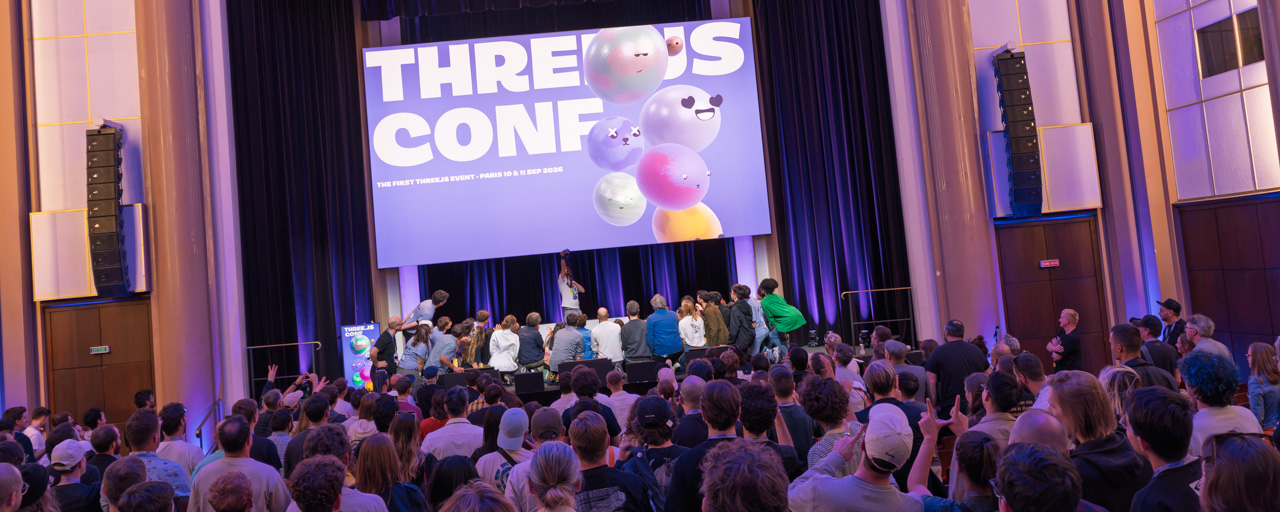
Three.js Conf Paris 2026 took place in Paris on September 10–11, 2026. It was the first conference dedicated to Three.js, the JavaScript 3D library. We traveled from Japan to attend on behalf of ICS. This article covers some memorable talks and the event itself.
Three things stood out:
- It was an opportunity to learn about both the creative and technical sides of 3D.
- It was a pleasure to meet well-known library developers and creators.
- The energy and culture of an international conference made the experience especially enjoyable.
Conference Overview
The venue was Maison de la Chimie, a conference facility in Paris. Its name means “House of Chemistry” in French. It hosts academic conferences, seminars, exhibitions, and other events. We were told that 550 people attended the conference.
▼ Attendees lining up before the doors opened. I did not know what to expect from the venue, so I arrived with a mixture of excitement and nerves.
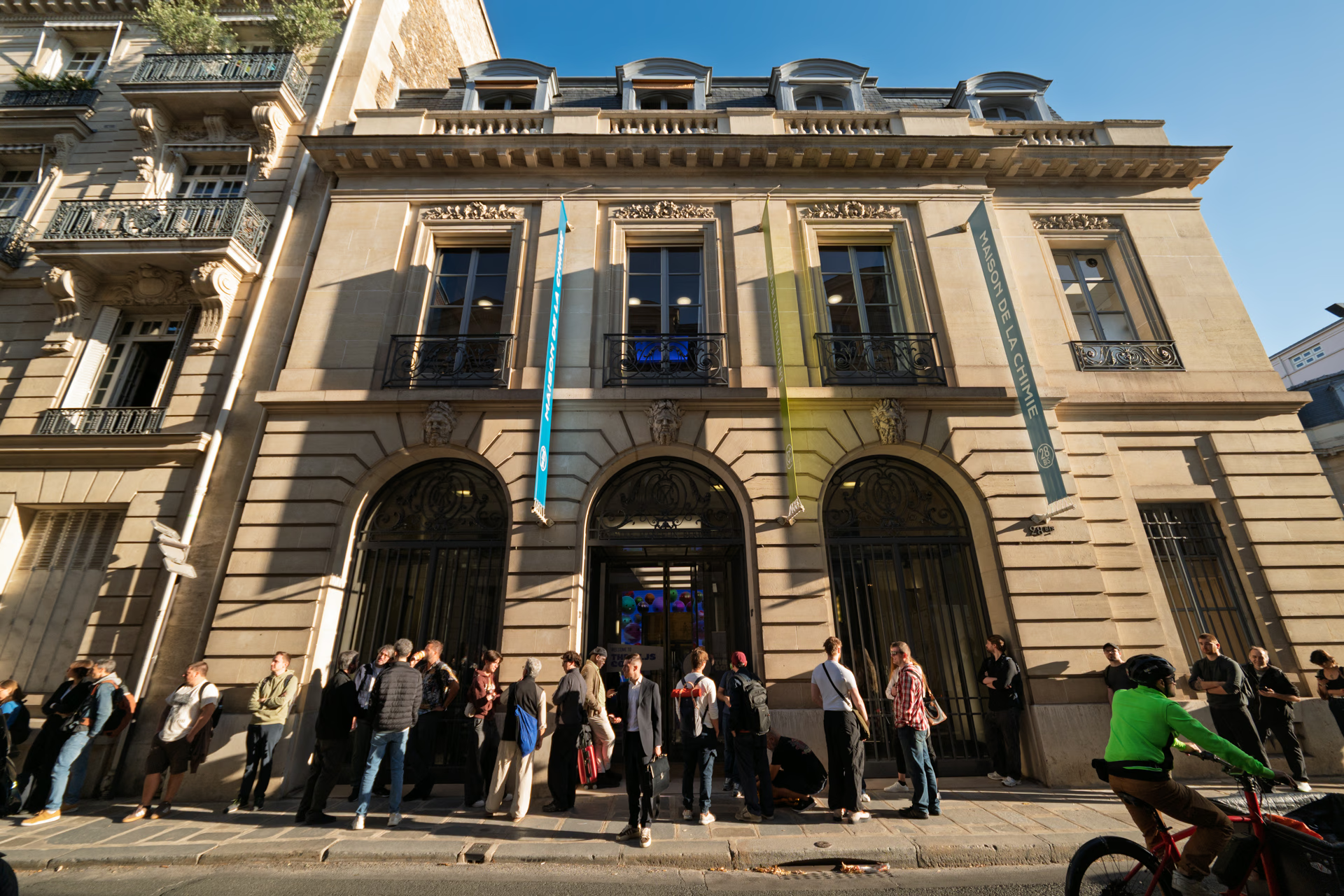
▼ The entrance to the venue

▼ The elegant conference hall

Memorable Talks
Before attending, I had imagined a technical conference aimed at engineers. However, many speakers were the creators of websites recognized by awards such as FWA and Awwwards, giving the event the feel of a creative conference.
Every presentation was inspiring. Here are some of the sessions that particularly caught my attention.
Mr.doob: Evolving Creative Tools and AI
Mr.doob, the creator of Three.js, spoke about his approach to AI.
He recalled manually painting antialiasing one pixel at a time to smooth the edges of images. Reflecting on how tools eventually took over that work, he placed the arrival of AI within this broader evolution of creative practices.
- AI now makes it possible to try ideas previously put off because they would take too much time.
- AI has raised the level of abstraction by one step.
- You can always return to a lower level of abstraction by reading or writing code.
- We will be fine in the age of AI as long as we stay curious.
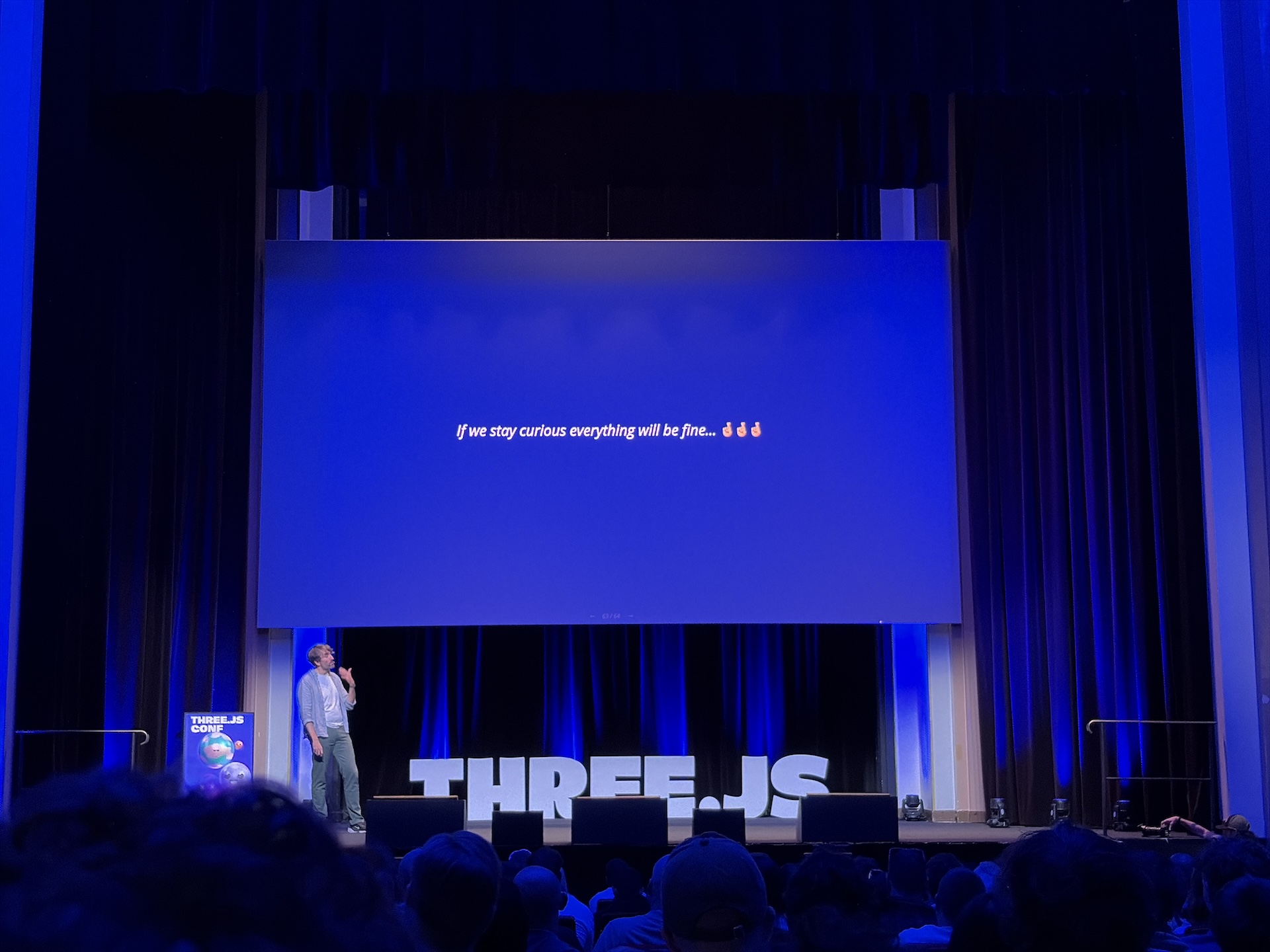
My Impressions
I had expected an introduction to the latest Three.js features, but the session focused more on mindset. It offered a fascinating glimpse into the perspective he has developed as a library creator.
Optimizing 3D for an Expo Installation
In “Performance and Tricks,” Renaud Rohlinger of UTSUBO discussed the optimization of “Waves of Connection,” an installation created for Expo 2025 Osaka, Kansai.
Inspired by Katsushika Hokusai’s waves, the work features waves of particles that respond to visitors’ body movements. According to the studio’s write-up, it animates up to approximately one million particles using Three.js and WebGPU.
The talk covered measuring rendering costs in milliseconds and progressively improving draw calls, depth processing, and other aspects of the implementation. Even after reducing the polygon count with a technique that uses a single triangle and a shader to make each particle look like a sphere, the computational cost of overlapping particles remained a challenge. He explained how they changed their approach: first recording the ID and depth of the particle visible at each pixel, then calculating color and shading.
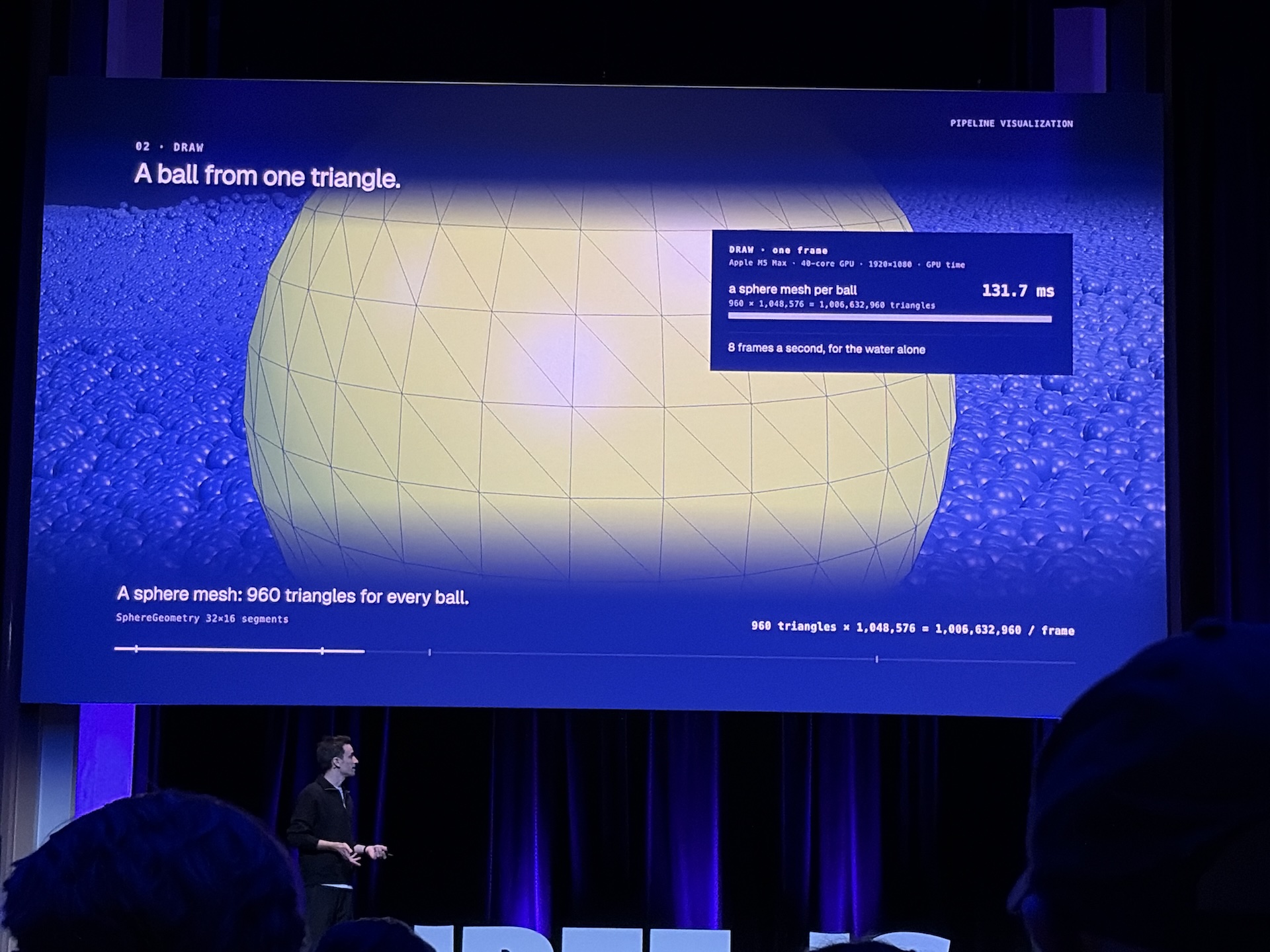
These techniques are available through Three.js BLOCKS as a library and skills for AI assistants. You can also explore the demos.
You can watch the talk in Renaud’s post on X.
My Impressions
I found this so interesting that I watched the recording several times. It was highly technical, but it was an outstanding session that made me think, “This alone made attending Three.js Conf worthwhile.” Even the presentation itself was built in 3D, and it was spectacular.
Seven Golden Rules for Creating Web Experiences
Three.js Journey is an essential online learning resource for Three.js. Its creator, Bruno Simon, gave this presentation.
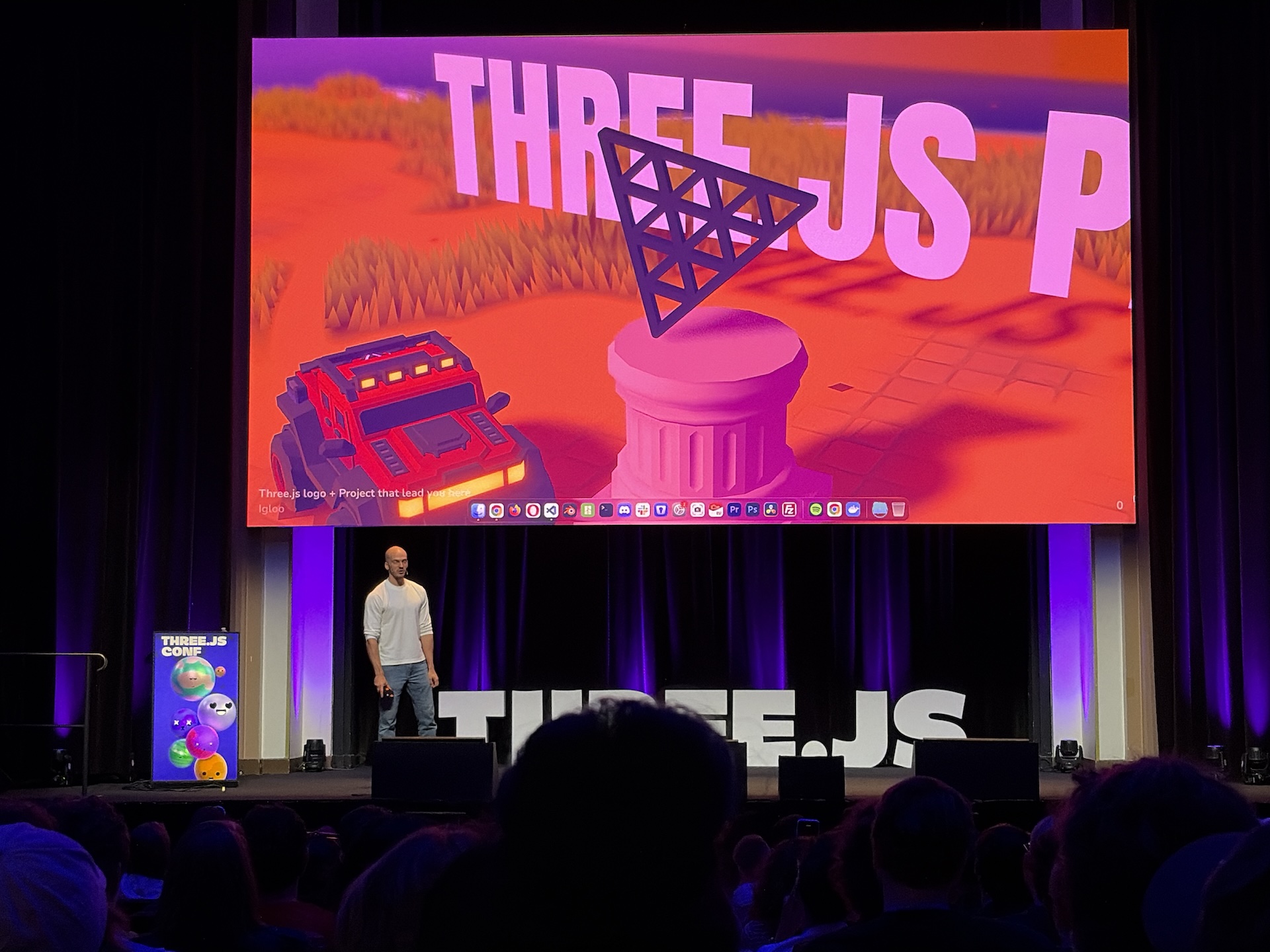
He opened with a provocative statement: “Nobody remembers a static website that only provides information.” He then introduced seven golden rules for creating memorable web experiences.
- Animate everything
- Use easing and inertia to give things an organic sense of life.
- Follow the “0.3-second rule” for click and hover effects. He warned that delays longer than 0.3 seconds cause frustration and break immersion.
- Keep it running smoothly on every device
- The moment the frame rate drops to 30 fps, immersion is lost and users may leave.
- AI struggles with performance optimization aimed at improving frame rates.
- Always budget time for performance optimization.
- Have one distinctive feature
- Create an interaction or mechanism that becomes the site’s signature.
- Iterate quickly
- Make it possible to adjust values on screen and try ideas immediately.
- Keep people entertained
- Reduce barriers before users can interact, and leave room for exploration and play.
- Treat sound as a core feature, not an afterthought
- Design footsteps, interaction sounds, ambient audio, and music as part of the experience.
- Plant seeds early and let them grow
- Collect inspiration from games, films, and other sources, and give the work time to develop.
- Copying something you have seen is not necessarily a bad thing; it can eventually lead to ideas of your own.
Anime-Inspired 3D Visuals
Vicente Lucendo shared the creation process behind Messenger, a 3D experience with a visual style reminiscent of Japanese anime.
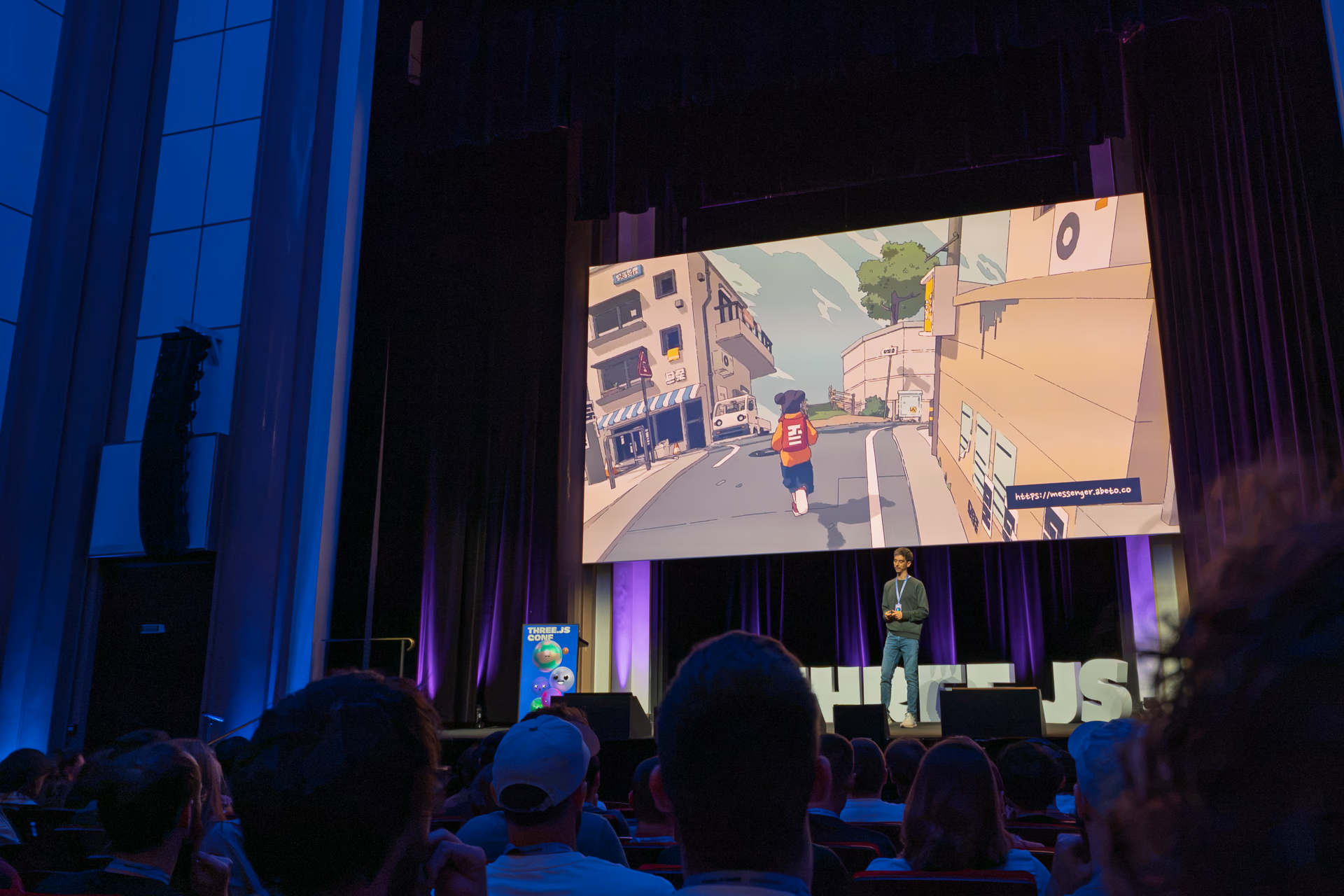
His references included footage of Asia and Japan from the 1980s, anime, and photographs taken during his visits to Japan.
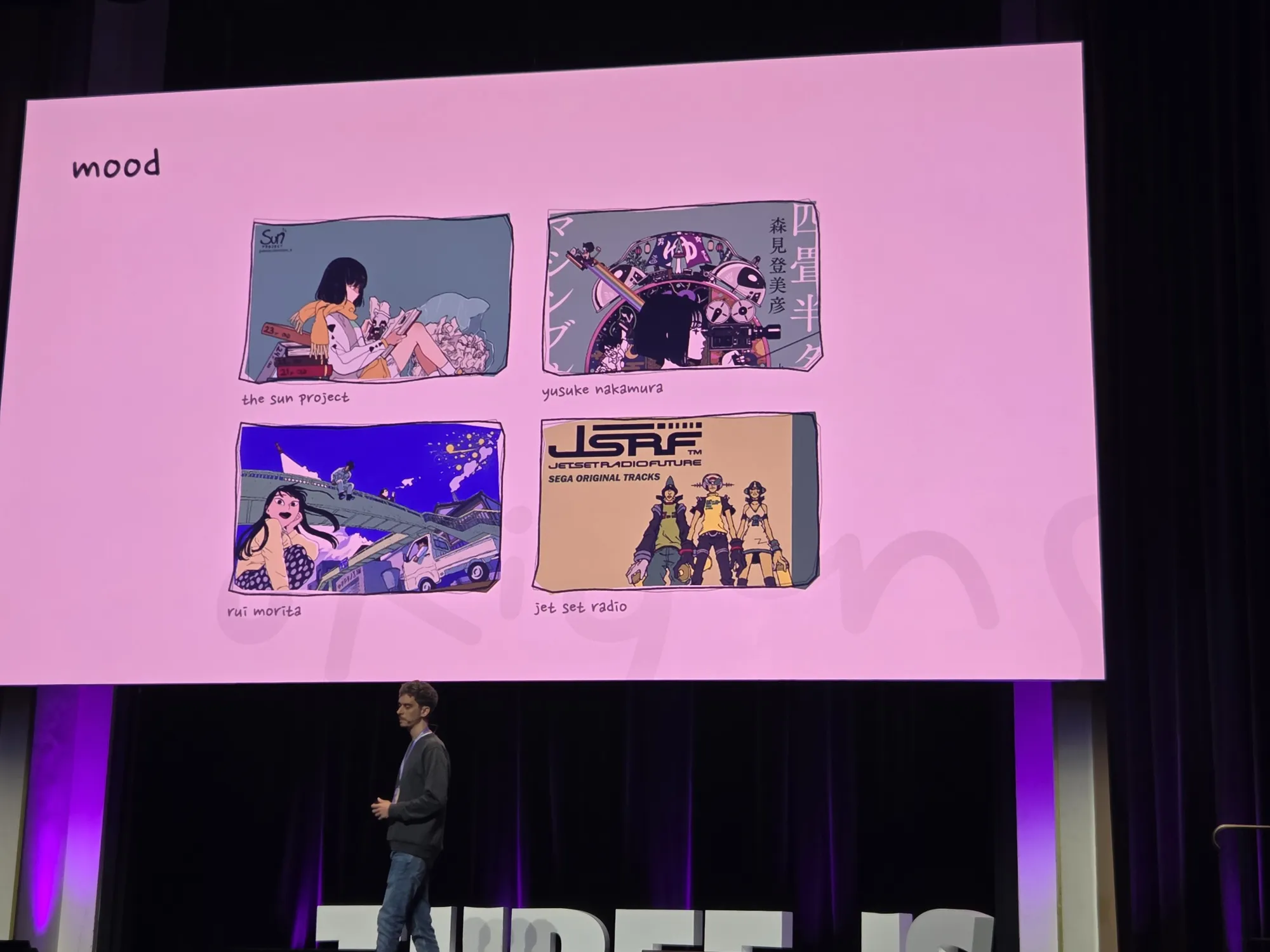
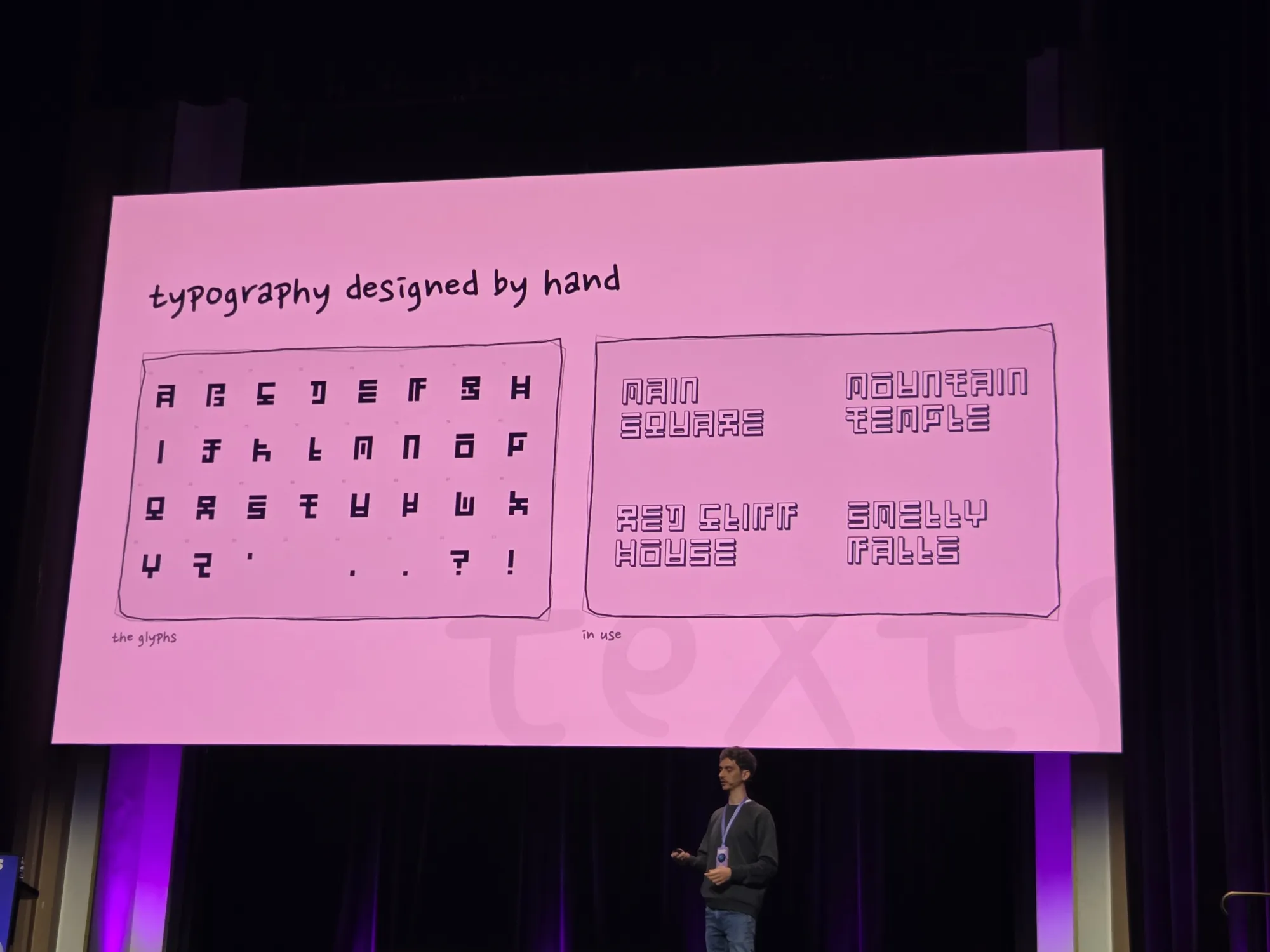
To evoke the feeling of being abroad and unable to understand the language, he also created an original typeface resembling kanji and Hangul.
He said that building the site without AI took a considerable amount of time—four to five months. Paradoxically, had he used AI, it might never have become such an ambitious game that he spent so much time developing.
My Impressions
At a time when front-end development can feel dominated by the idea that “using AI is the right thing to do,” hearing about development without AI left a strong impression on me. His emphasis on creative sensibility made me reflect on what creativity really requires.
Photorealistic 3D and Performance Optimization
Anderson Mancini, who came from Brazil, shared practical techniques for creating projects with WebGPU.
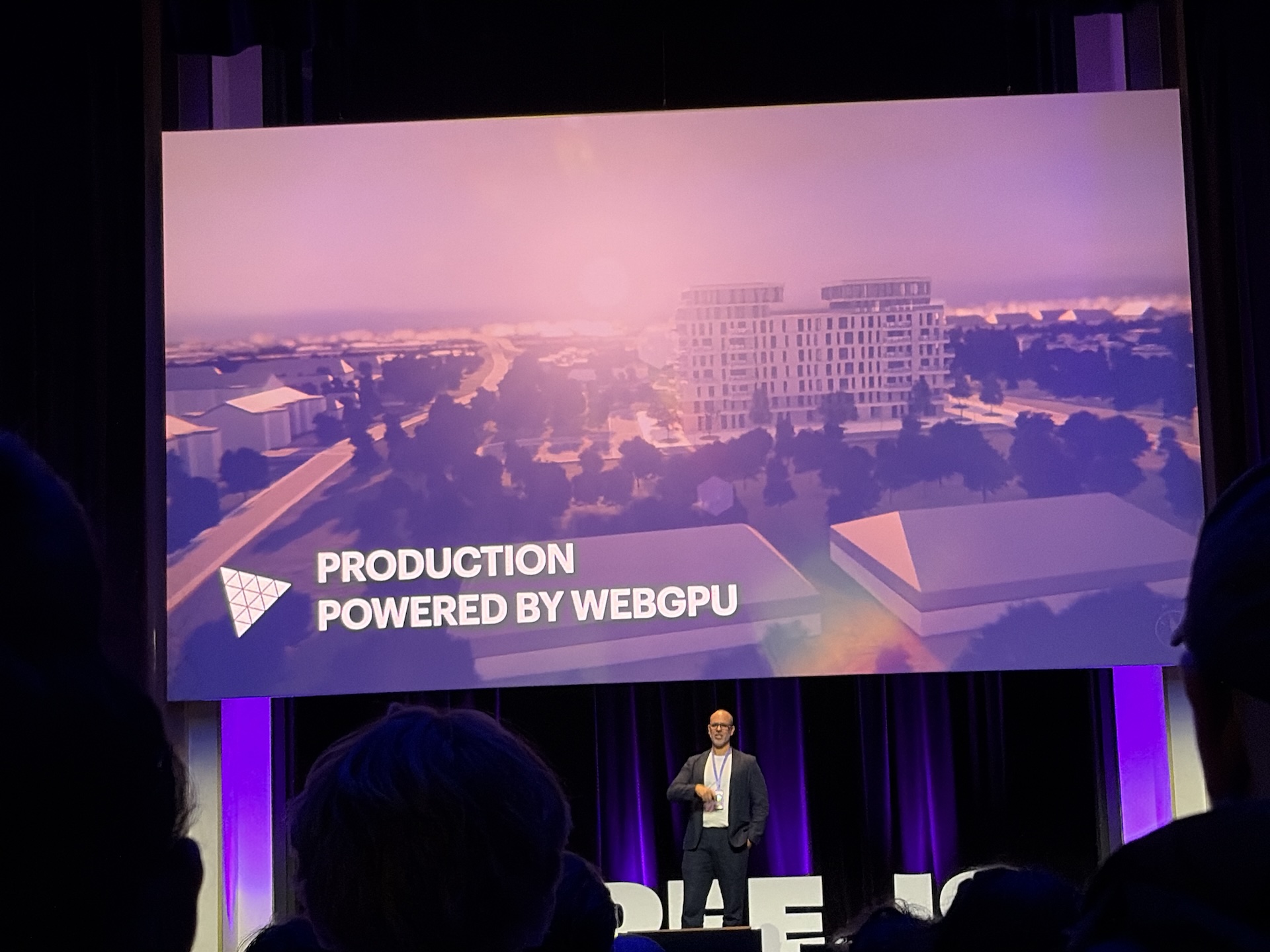
Using Planpoint 3D Archiviz as an example, he explained finishing touches for a photorealistic look, such as chromatic aberration, depth of field, and lens flare. He also discussed estimating the cost of light sources and post-processing effects to balance visual quality with rendering performance.
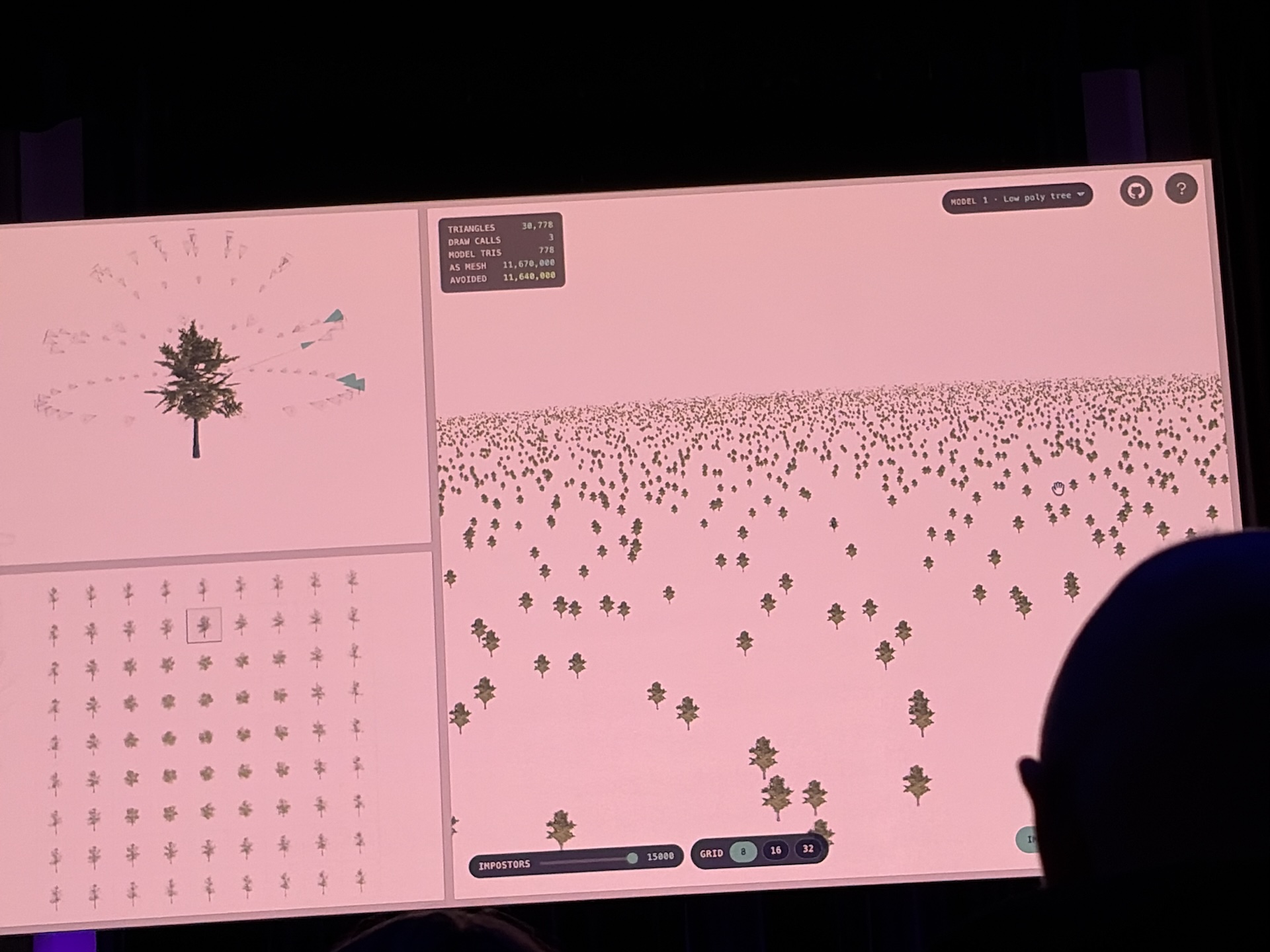
A key optimization technique was Octahedral impostors. A 3D model is rendered from multiple angles, and the resulting images are packed into a single texture atlas. Images are then selected according to the viewing direction and displayed on a flat surface, allowing large numbers of objects such as trees to be represented with very few polygons.
My Impressions
Anderson said he had started learning 3D only five years ago. I was amazed that he had developed such skills in so little time. Apparently, he had been putting in 16 hours a day…!
I was also thrilled to discover that he created WindLand, which we featured at the beginning of the ICS MEDIA article 簡単で効果大! Three.jsのポストプロセスで映える3D表現!
Announcing the Next Major Version: GSAP 4
During the session on the animation library GSAP, Cassie Evans announced GSAP 4, the next major version following the current GSAP 3. With GSAP 3 having launched in November 2019, the announcement pointed toward the first major version update in nearly seven years.
It was exciting to be there when new features were announced!
An Animation Editor for Anime.js
The lightning talks gave each speaker just two minutes, with one presenter quickly following another.
One that particularly caught my attention was an editor demo by Julian Garnier, the creator of the animation library Anime.js. He demonstrated a tool for editing animations on a timeline and generating Anime.js code.
Venue Design and Merchandise
A great deal of care had gone into the venue decorations and merchandise, too.
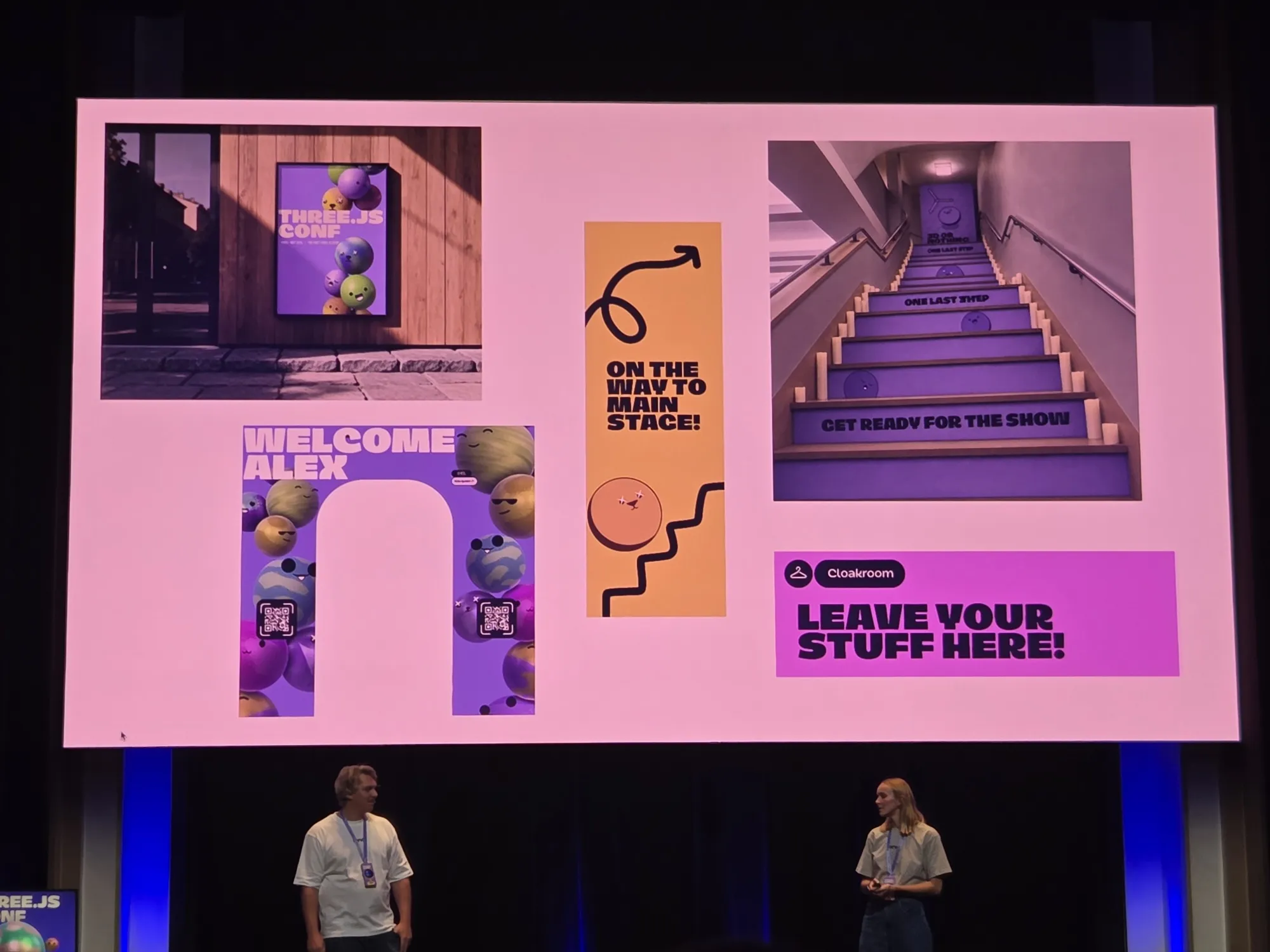
Hervé Studio, which handled the art direction, reportedly spent about seven months preparing everything from the official website to the merchandise. They also shared how they revisited the initial concept and worked toward a website that would convey the community’s excitement even before the event began.
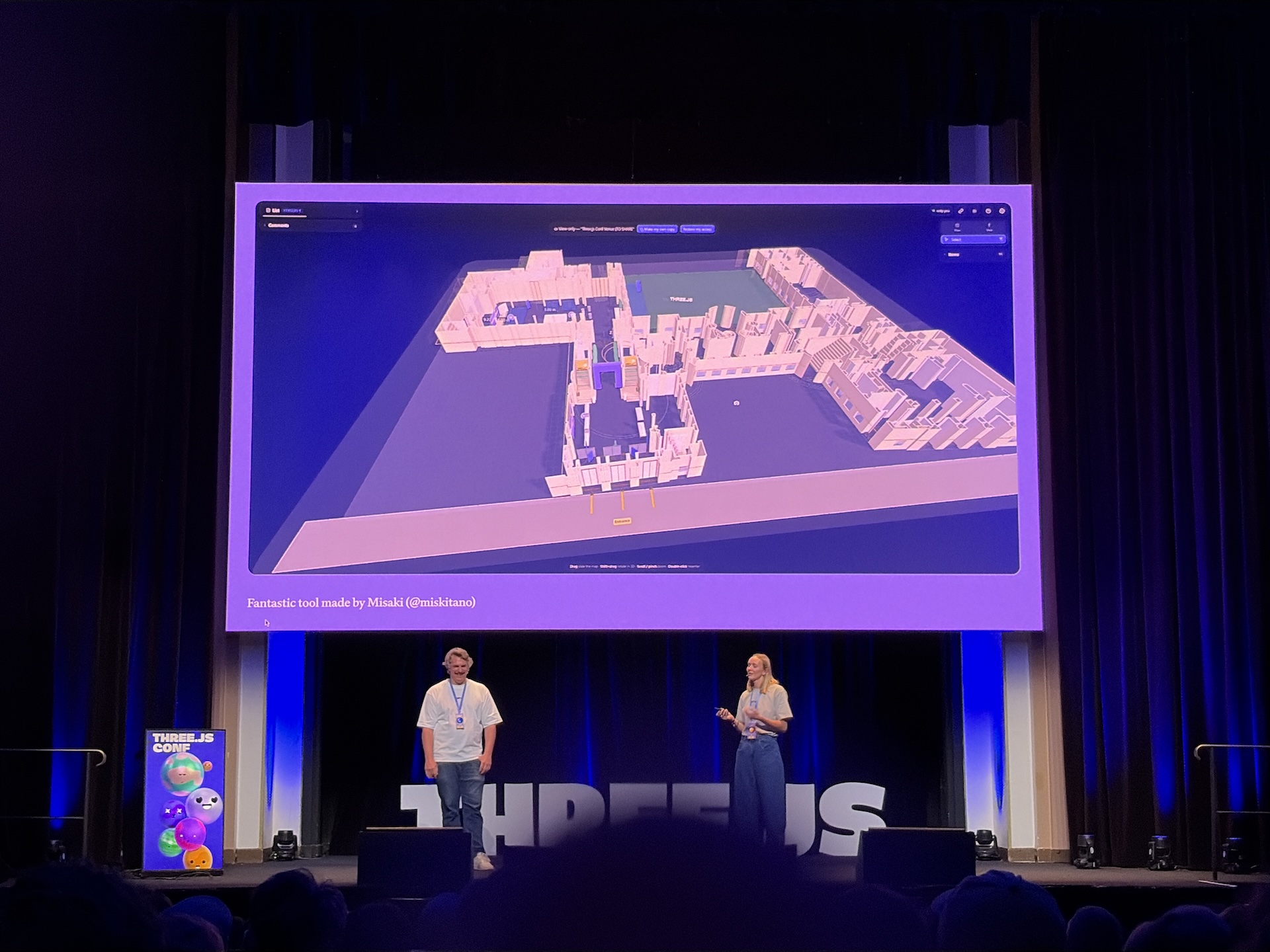
▼ The stage in the lobby

▼ An attendee badge

Speakers received electronic badges loaded with digital content created specifically for the event.
To my surprise, these were handmade, and they apparently only became functional about a month before the conference.
An Afterparty on a Boat
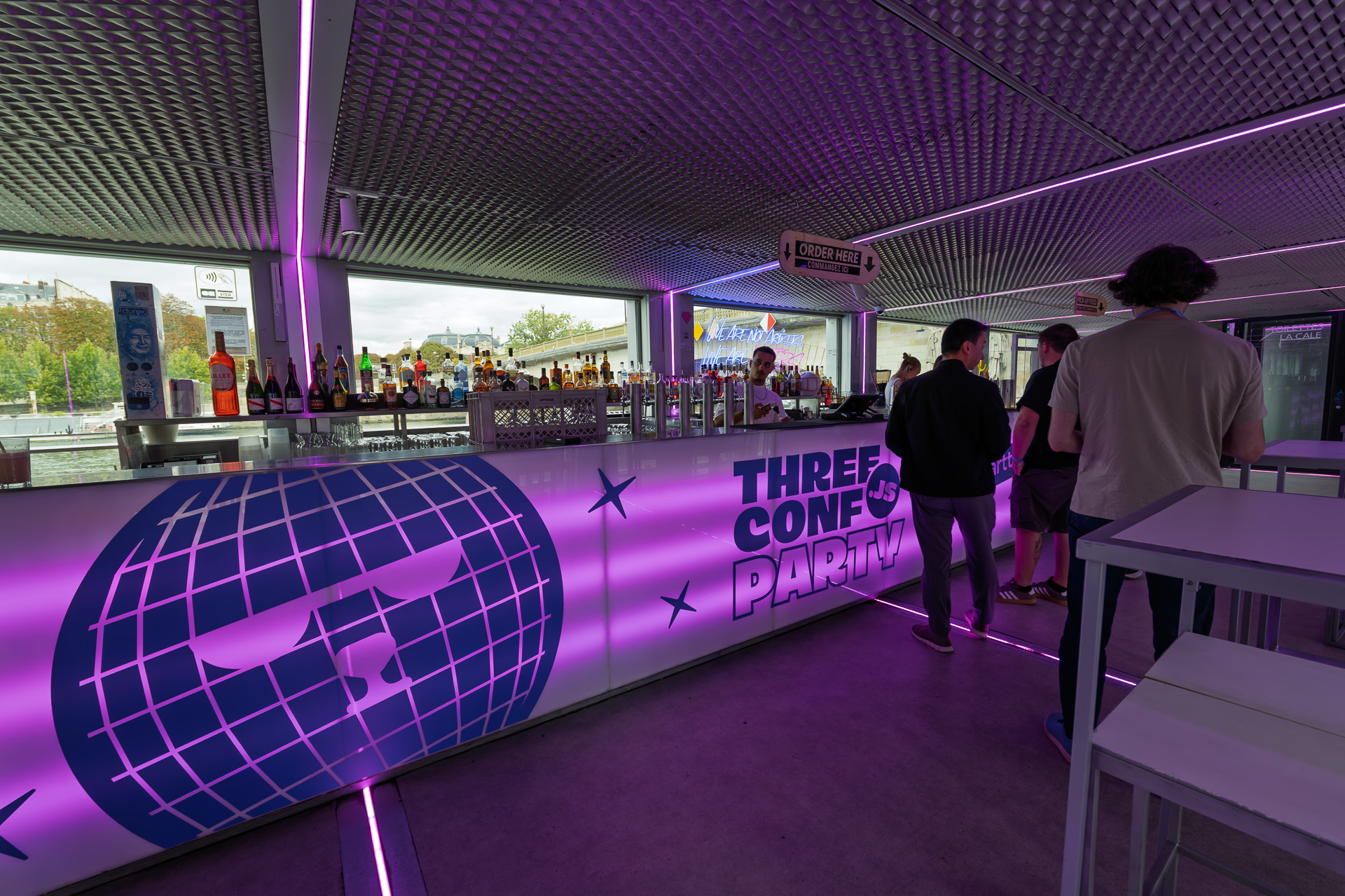
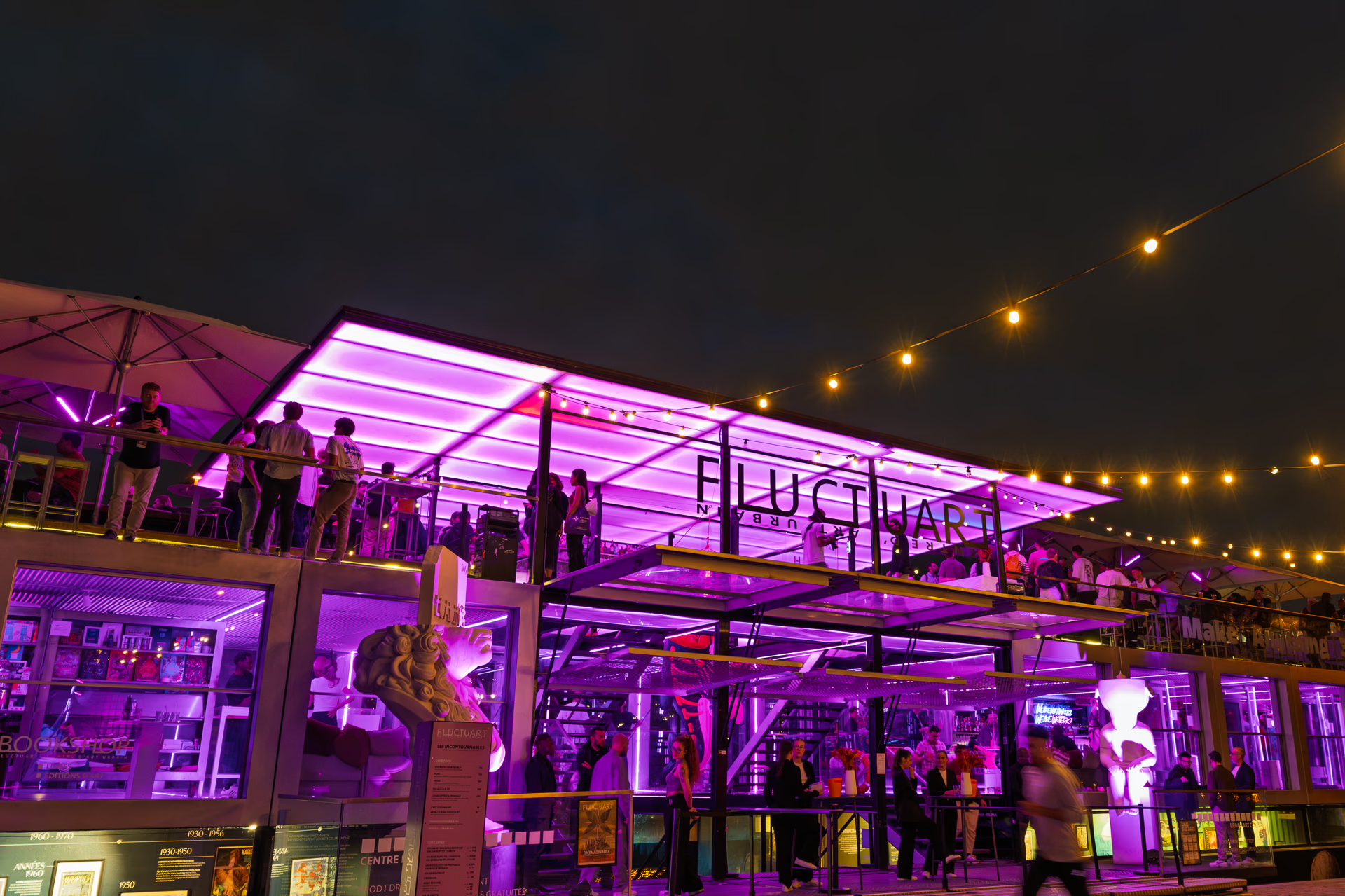
On the evening of the second day, an afterparty was held on the Seine. Having a party on a boat made it feel truly special!
▼ The boat’s bar counter, decorated for the event
▼ The afterparty venue
Meeting Attendees and Speakers
I also spoke with the organizer, David Ronai. David implemented the official website as well. In his write-up, he describes optimizations using techniques such as compressed textures and OffscreenCanvas. He has also been an early adopter of HTML-in-Canvas, making full use of technologies related to Three.js.
He told me he had been programming on his laptop even while traveling. The amount of energy he put into making this event happen must have been enormous.
When David realized during our conversation that I was “clockmaker,” he became incredibly excited. “You’re Clockmaker!!” “Your work gave me so much inspiration—thank you!” He told me this several times and introduced me to friends who knew my work from the Flash era. 🤣
I also took photos with Mr.doob and David.
I had the chance to connect with many other people as well.
- Cassie from GSAP
- I knew her from the GSAP tutorial videos and was delighted to meet her in person, so I went over to say hello. After I introduced myself and mentioned that I write GSAP tutorials in Japan, she gave me a GSAP bag—apparently one of only three she had left.
- Julian from Anime.js
- He came over to talk to me twice during the conference. We had plenty to discuss, from the library to the differences between Japan and Paris.
- Dennis Smolek, who contributes to React Three Fiber
- He told me he normally lives in Japan, and we had a great conversation!
- Attendees from Shopify in Canada
- They were the people behind Shopify Live Globe 2025. Shopify has produced some remarkable web experiences in recent years, including Shopify Editions | Winter ’26. They said they typically build these sites in about two months, during which things get incredibly busy. Still, creating work like that in just two months is amazing!
- Rob Bateman, a developer of Away3D
- He is a developer of Away3D for Flash and WebGL, and his work had been a tremendous help to me. We did not meet at the venue, but after the event I learned that he had attended, and we exchanged messages on X.
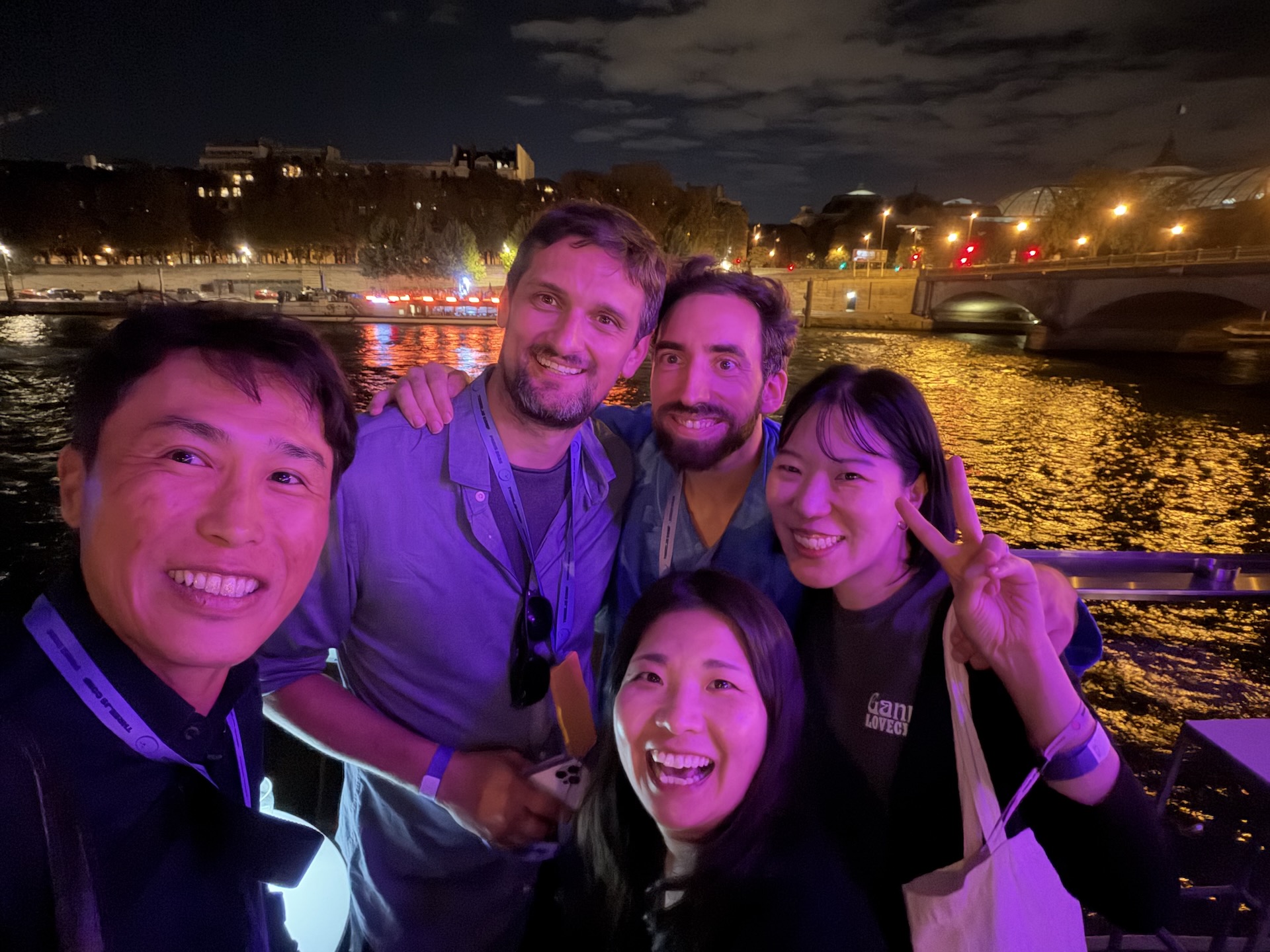
▼ A group photo at the boat party on the Seine
A Fondness for Flash
Flash came up often throughout the event.
Conversations touched on Japanese Flash-sharing platforms such as wonderfl, as well as Japanese creators such as Saqoosha. Bruno’s slides also briefly featured 全日本バーベイタム選手権, a 2009 Flash website by Kido.
It made me nostalgic to remember how much attention creative websites from Japan received during the Flash era.
Live Translation Makes International Talks More Accessible
Both Apple’s Translate app and the Google Translate app offer live translation features (Google Translate added the feature in March 2026).
AirPods Pro and live translation proved helpful while listening to the talks. After trying both apps, I felt that Google Translate produced more natural and accurate translations.
The presentations were given in English and French, and I felt I was able to follow roughly 40–80% of the content in either language. It made attending an international conference feel more accessible.
Conclusion
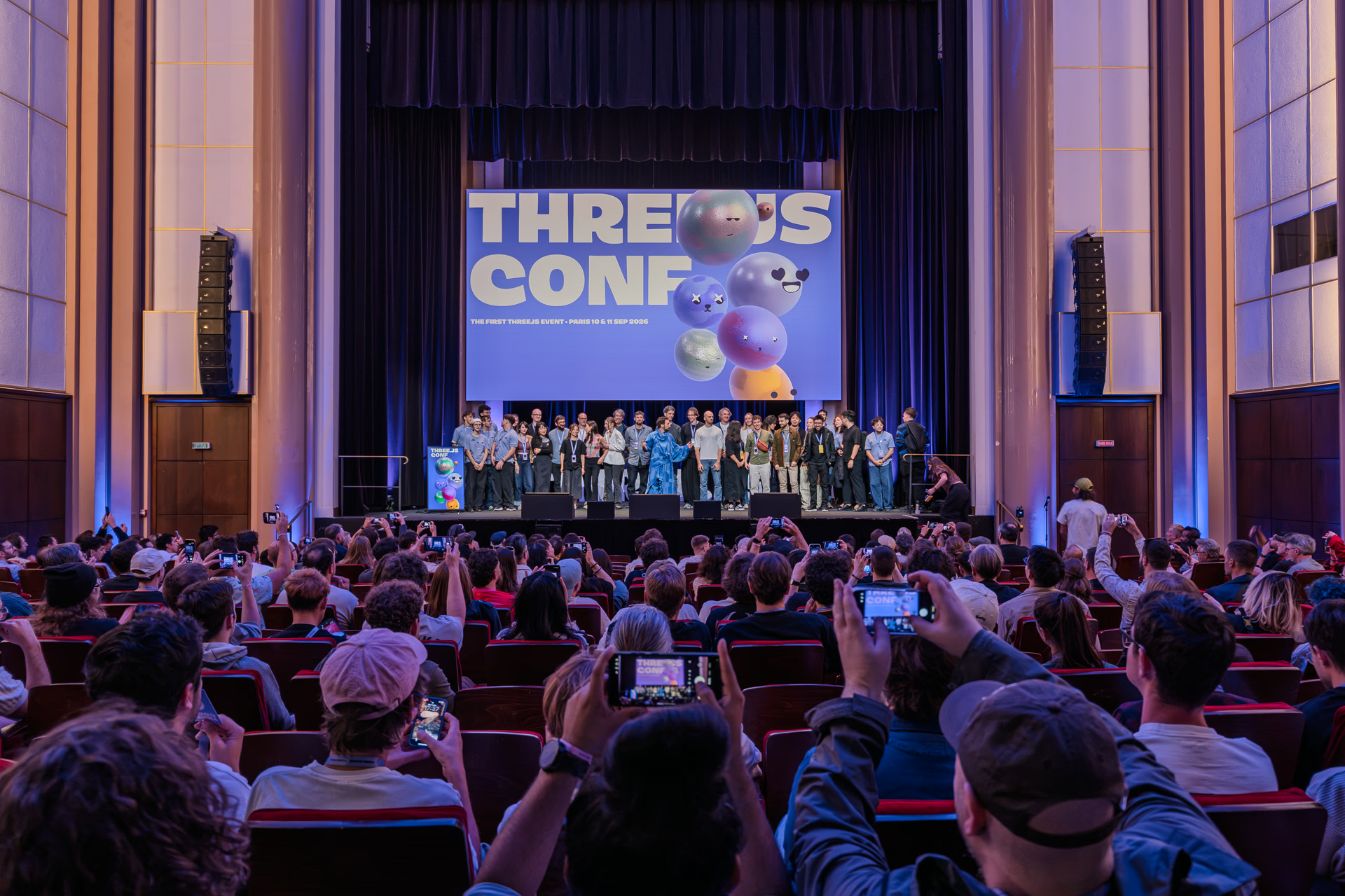
These were two days I was glad to have experienced. ICS has attended conferences in the United States several times before (see our reports), but this was our first conference trip to Europe. We learned about the event in February 2026 and spent roughly six months preparing for the trip.
The weak yen made it far from inexpensive, but even so, I came away thinking, “I have to attend again!”
Some of the people we met were interested in technology and creative work from Japan. Despite the geographical distance, I felt a real closeness to the people who share our passion for making things. I hope there will be another edition—and that more people from Japan will join us next time!